
Big Chicken Rundown
Why can't I count them & what do they have to do with the fact that there is no ethical consumption under late-stage capitalism..

I know they say April comes in like a lion, out like a lamb. What do they say about May?
I started this newsletter write-up in early May, still chipping away at it as one month swells into the next, three weeks of reflection each seem like they’re years apart from the other. The speed with which Spring starts to unfold is astounding, especially in the contrast with moments of day-to-day slowness, longer daylight hours, gentle breezes on the porch with lilac blooms & birds chattering away, and an unending to-do list. Market season is ramping up, all three of our regular season markets are full on, it’s been such a treat to see everyone. We’re finally restocked on our pasture-raised chicken after selling out over a month or so ago. It’s been four months since we’ve had chicken thighs!
With an influx of new subscribers & a very-much-unexplored newsletter platform, I thought we would make a brief (re)introduction, as well as an introductory chat about chickens in silvopasture. Next month, we’ll chat a little more about sheep, breed selections, fiber & sustainability ahead of an event in July all about wool & sustainability.
Meadowfed Lamb is a silvopasture operation, home-based in Hadley, MA with Preservation Orchard, iykyk. Really briefly, silvopasture is the integration of grazing animals and tree crops. We started our project in cooperation & collaboration with Carr’s Ciderhouse, and later the no-till veggie operation Preservation Farm, run by grower extraordinaires Ava & Joe. The orchard is largely apples, pears, heartnuts & chestnuts, and also includes large but newer plantings of persimmons, hazelnuts, honey locust & cane fruits, currants, etc.
The benefits of silvopasture are numerous & wide reaching, whole system, micro & macro levels of goodness. A central tenet is shade for the animals, keeping stress levels low. I can’t stress how under-appreciated shade is for the health & wellbeing of livestock. They grow better, they feel better, they graze more efficiently & evenly. Their wool grows better. The animals follow the dappled shade of the orchard floor & tree lines. This means that manure is more evenly spread throughout the orchard, instead of concentrated under a shade structure. The trees get fertility from small amounts of manure deposited during grazing, and the animals don’t disturb or compact the soil as much as equipment does, like trucks, tractors and implements. The soil microbiome is fed and nurtured with the manure & light cultivation of grazing sheep & chicken scratch. The stimulation of grazing makes the grass grow & root down. Grazing encourages forage to root deeper which means water is retained or better absorbed. Markers of ecological health at our farm like plant diversity and wild bird nesting populations are much greater & the grazing helps with pest control on the orchard crops by staggering insect life cycles and maintaining orchard hygiene. I could list things forever.
We are going into our eighth season grazing the orchard and have since added two more diverse orchard sites to our grazing plan with Big River Chestnuts, in Sunderland and South Deerfield. There is so much to talk about in that collaboration, as well. The sheep loop through those properties and provide a great service in the conversion of annual agriculture to perennial ag at those properties. More on that, as it pertains to the sheep, next month.
I didn’t anticipate becoming a chicken farmer. They were, maybe unsurprisingly, the first farm animal I had any experiences with. Chickens are also the first animal I ever processed for food, start to finish. I was in Georgia in the middle of the state where there is a small, certainly magical homestead & permaculture farm called Salamander Springs. The owner, teacher & visionary, Debbie, started it from nothing- literally a paper plantation gravel pit, turned orchard, market garden & education center. Built with a lot of love, cobb, reclaimed wood and cardboard. There is a double wide full of well loved books, a fresh water spring, and (so many) dogs. Chickens, occasionally pigs, lots of jam.
On my first trip there, I was tasked with dispatching an aggressive rooster & prepping him for dinner stew. I had no idea what I was doing, making it harder for myself by starting late in the day. This meant I had only a headlamp to light my way, a dull kitchen knife and a very old edition of The Joy of Cooking, which to my great relief had rudimentary step-by-step for how to gut & butcher a chicken. I think I learned a lot, less about how to do something well, but it was a real moment for me, one of several in my early farming journey. About death, courage, food.
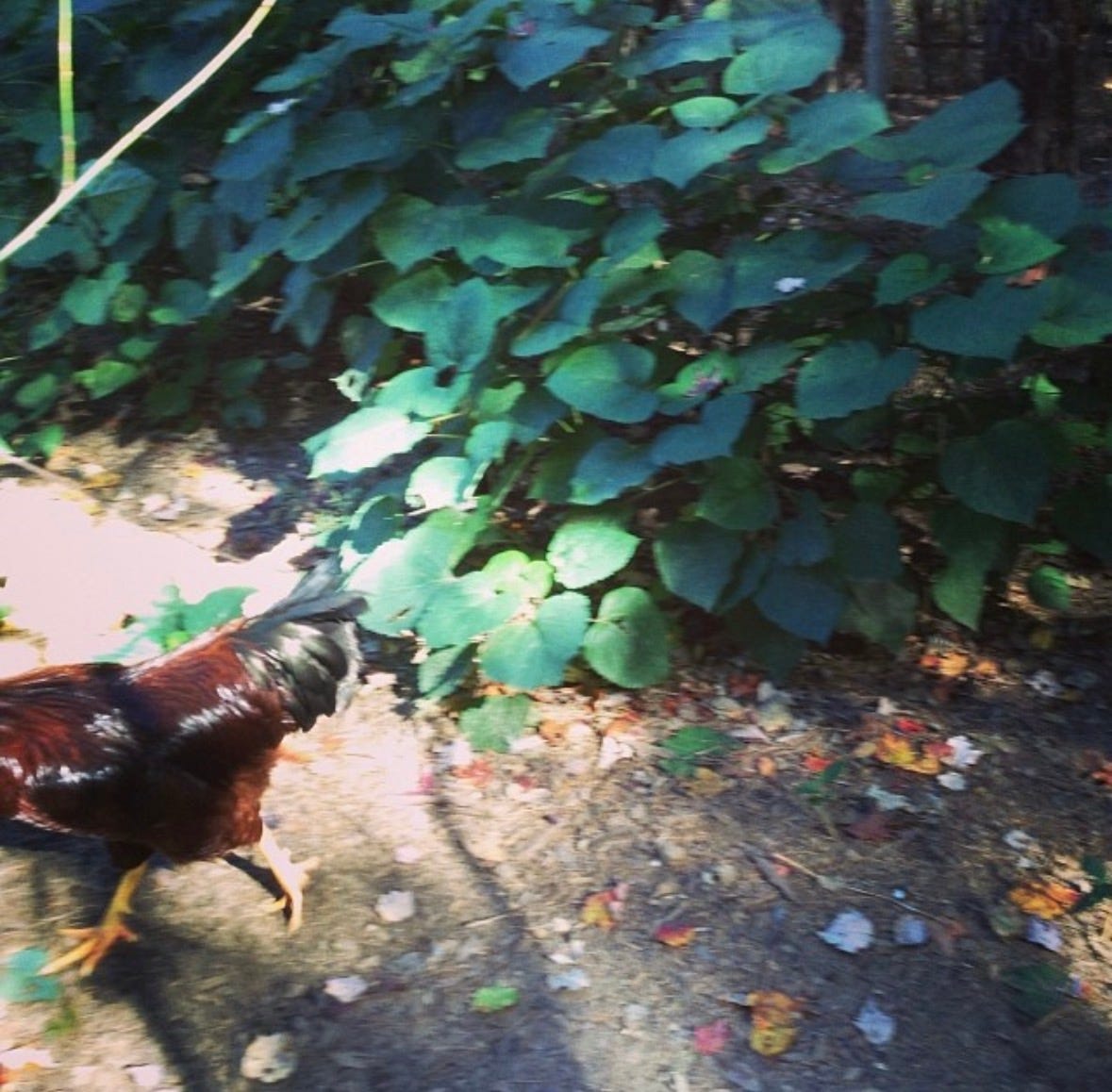
This is actually that rooster, taken on a disposable camera in January 2012.
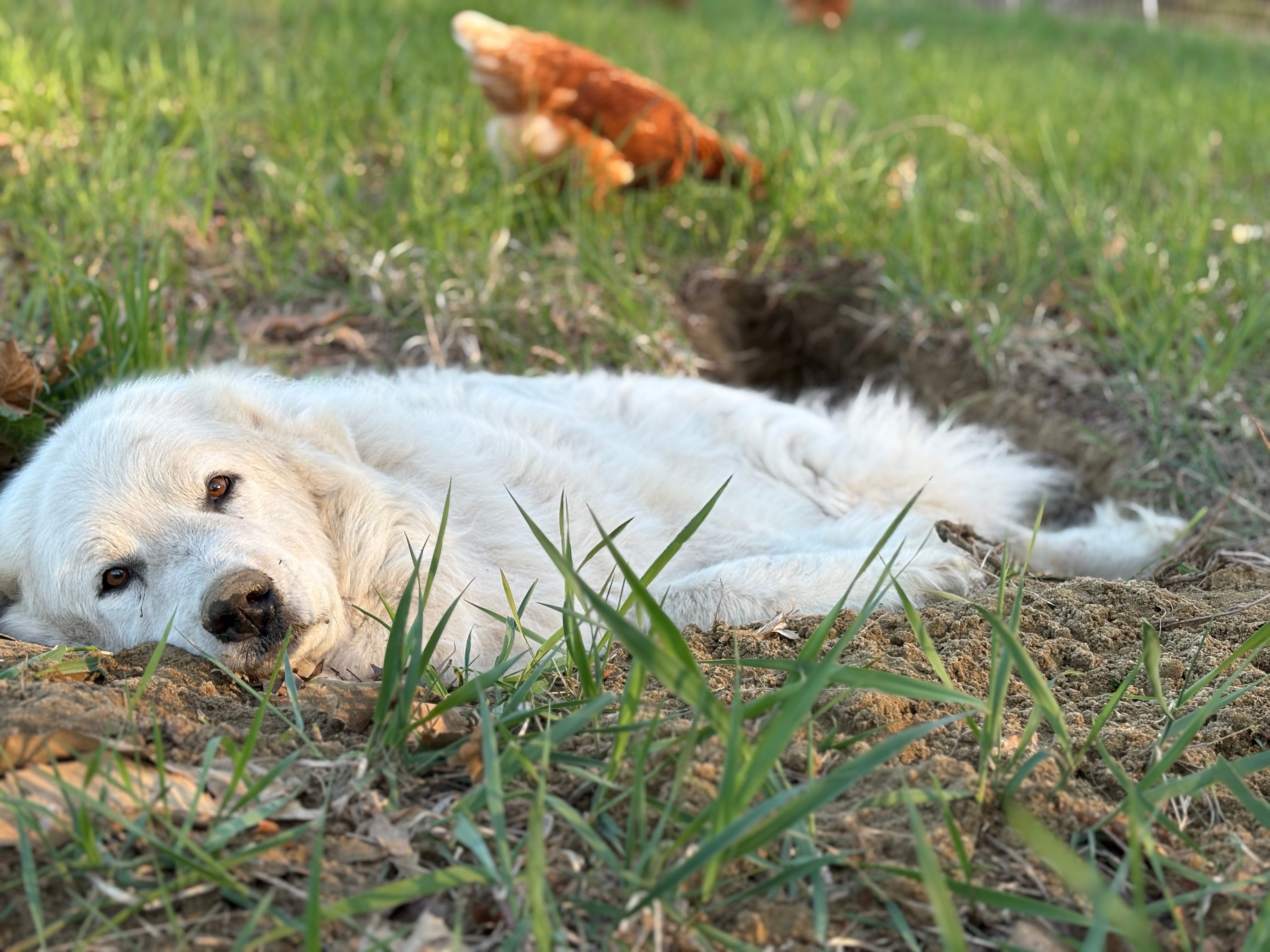
That was about 15 years ago. Now, we run almost 1000 broilers (chickens bred for meat) & somewhere around 400 layers (chickens bred for egg production.) We have two very large, very sweet, senior Pyrenees who protect the egg layer flock, Lucky & Thor. We spend a vast majority of our money on feeding & processing these chickens to be a part of your life in one way or another, and most of our daily chores revolve around working them around the farm. I guess that’s a soft way of me saying that they sort of rule our lives.
I’m not even entirely sure how many birds there are laying eggs for you every week. Honestly, it’s so hard to count chickens, even when they stream to a new paddock in an orderly line. The fickle beasts.
There were many things that led to adding chickens into the dynamic fold of our farm project. We integrated the broilers into the system first. Mostly because it is very hard to get high quality chicken, with transparent feed & management. During peak Covid, the Preservation Orchard and Farm project was really in its infancy. Before the no-till veggies were introduced to market, the vegetable production at the orchard was a small community growing project, with six families tending no-till storage crops. For a brief moment, we did broilers as a part of that, which was my first time participating in the management of broilers at any kind of scale. The meat was unmatched and when the larger group decided to focus on veggies, Matt and I took over the broiler enterprise within Meadowfed Lamb’s purview. We expanded from one batch to four batches of birds a season (May to Oct.) and now we run five rounds, totaling 1000 birds/year, April to November.
Something that sets our broilers apart is the breed of broiler we use. Meat birds, categorically, are notorious for their growth rate–often at the expense of their quality of life. That’s a pretty boiled down personal interpretation of the high-production broiler breeds (like Cornish Cross and the Cobb 500); I don’t like raising them, and I don’t like the way they taste. We prefer the slower growing ranger-type birds.
One year, we had a massive & devastating weasel attack in our brooder which was full of two-day old chicks. We called every hatchery we could for replacements, because in order to make our processing date, we had to start over with new hatchlings and our regular hatchery & breed wasn’t available in the necessary timeframe. After calling everyone, we could only get a replacement batch of cornish cross - the classic high production white meat bird. We grew them just that once and I swore that if we had to do it that way again, I would be out of the broiler business for good. The birds feathered out so slow that their time on pasture and out of the brooder was limited, they ate an immense amount of grain and barely behaved like a chicken. Sure, they grew fast & big, which is good for the profit margin, but for me, that’s not a good enough reason to compromise on all around quality.
These, of course, are management choices. The alternative birds that we raise are called Freedom Rangers. They are a red, free-ranging meat bird which grows more slowly and has superior flavor, far above and beyond what cornish cross birds offer. They have retained the natural foraging behaviors that chickens ought to possess, some folks even keep them as llayer hens. They have plenty of energy to consume grass, insects, and seeds while cornish cross chickens basically loaf around and consume nothing but commercial grain. We find them to be a pleasure to raise, more harmonious with our management style.
The thing about all that, is that those management choices impact the customer. Those (negative) impacts are financial, the positive is nutritional. I was tempted to write ethical, as a positive impact, but the problem is that the financial barriers to accessing healthy, organic, animal & land centric food are fundamentally unethical, at all - it’s capitalism! And that’s not good! Our prices aren’t what they are because we are charging you for our time, or work- we’re covering the costs of processing & feeding while trying to feed ourselves. We, like many many other farms that we know, are on food assistance.
Raising this alternative breed of broiler chicken is more expensive in every way – a higher cost per day-old chicks, the slaughterhouse charges us a surcharge for not raising cornish, the birds are smaller for the same growth period as the crosses. But, customers shouldn’t shoulder the cost difference- partly because there’s no expectation that you could tell the difference when you’re buying it- unless you’ve asked. This means in order to meet market prices, we make much less profit per bird. But again, it’s worth it. Because the point is to raise the schmaltzy-est, tastiest, healthiest birds with the best impact on the land & highest possible quality of life that we can give. That means I want to raise chickens, not meat-machines. Does that make sense?
What I have to say for full clarity- the most important thing is that people are fed, families are fed. We acknowledge that we’ve not met our dreams of accessibility by farming. The costs of doing business are profound, honestly. So we totally understand & are always brainstorming on ways to alleviate sticker shock, and would never fault someone who chooses a more affordable option. NO shame in getting the protein you can afford to eat, period.
What matters to us, is that the information is available & collectively we’re always trying to figure out how to get the best quality food to people, to everyone. I want everyone to eat the best food they can possibly eat, but I can’t stomach people struggling to pay other expenses, struggling to afford food, or skipping meals. Good, high quality food should be accessible, and I know it’s not.
We provide food across three counties in Massachusetts & two states from a formal market setting, to literally thousands of people. I spend a lot of time talking to customers about access to food, food assistance programs, management & sustainability. A big part of that experience is hearing how folks interpret and make choices around the information they have about the food they consume- assumptions, facts, things they’ve learned or been told. Everyone wants to get the best food they can, from the happiest animals & the most pastoral of settings. Most of the every-day available information is what’s being marketed to you at grocery stores. That information is marketing. A trend we see is the increasing distortion of really valuable ‘key’ words and ideas about animal welfare and sustainable management, for the sake of validating higher pricing or at least setting one product over another. A lot of the common, desirable labels like ‘organic’ or ‘regenerative’ or ‘cage-free’ or ‘pastured’ do not mean what they logically should to you, as the customer. They have been muddied to fit into a larger production system that views the farmer and the customer as cash flow. This is a big part of the reason why the quality and nutrient-value of our food has so diminished & why it’s getting harder and more expensive to advocate for yourself. We’re all feeling that across the board, and it leads to a lot of mistrust between customers and food providers, and that breaks my heart.
Some of you may already know about our Meadowfed Community Coupon Fund. This system provides an avenue for customers who can afford to pay a little extra for their food to help out neighbors who may be struggling. Folks can make donations to the fund, or round up purchases by any amount they choose. For example, someone may purchase $45 of eggs and meat but could afford to spend $50 total. The extra $5 would go into our community fund as a coupon that any customer who feels they need a little financial help to afford this high-quality food can use. If every one of our customers decided to round their purchase up to the nearest $10 – then we would be able to feed dozens of families without anyone having to feel the financial stress of choosing to buy healthy food over purchasing other basic necessities. So - if you see us at a farmers market - please consider making a donation or rounding up. We witness customers who have made purchases using community coupons breathe epic sighs of relief and who have shed little tears of joy. It’s a powerful thing to learn that your community is looking out for you.
You can make a donation by becoming a paid subscriber to our newsletter on Substack - or also when you visit us at any farmer’s market appearance. Your generosity will stretch far beyond what you may realize.
A big part of our business & a big part of our presence at farmers markets, has been our eggs. Once we felt comfortable and well-practiced with the broilers, we started a small layer hen flock. We started with 100 birds, which over the last four years has blossomed into maybe 400 hens, and three showy roosters. Again, it’s so hard to count chickens, somehow it’s not as simple as some addition and subtraction.
We run a mixed flock for the multi-colored egg dozens you’re used to seeing at market. We’re so grateful for the way selling eggs has brought so many of our regulars into our lives week-to-week. The layer hens also impact the orchard in a great balance with both the sheep & broiler rotations. Their impact is less concentrated, more broad, and covers a much larger swath of the farm each year, mostly following the sheep flock. Where the broilers give huge energy to young tree plantings, the layers give our grasslands some serious life, especially noticeable over the last few years of drought. Monitoring both the speed of regrowth, with layers following the sheep, as well as the staying power of our stock-piled grass through drought and dynamic temperatures in the end of season, even the early spring regrowth has sped up- we actually couldn’t do any of this without their input. Honestly, the eggs are kinda secondary to their maintenance in the orchard.
Of course, I would be remiss if I didn’t mention our sweet, beautiful, perfect, hardworking guardian dogs. Three of our four dogs have valiantly guarded our layer hens since their introduction to the farm (the fourth is a super duper chicken eater, Cash. He’s not really allowed near them.) The first, and mightiest is Athena. She’s the guardian dog that has been with us the longest, our queen. She started her tenure with us guarding our sheep after the passing of our original guardian dog, Guard. But, true to her beginnings, Athena held a strong preference for chickens & once we brought her a young companion for the sheep, she clearly communicated a desire for reassignment. She guarded them with an iron first until she got deathly ill last spring and needed to be removed from duties. She spent nearly a year recovering at home, before returning to the orchard to guard the rams- for whom, she glows with pride.
The week Athena was removed from the farm (and was at Tufts ICU) there was a bear attack in the apiary at the farm. Basically reducing the stand of hives to toothpicks. The hens were one field over, and with the knowledge that bears hold a particular love of chicken grain and that Athena’s prognosis was very serious, we needed to find immediate cover for the flock. Matt drove twenty plus hours round trip to the middle of Pennsylvania to pick-up a retired-from-breeding dog duo, Lucky and Thor. They’re older dogs, we’re not sure how old and they came to us in somewhat chaotic physical condition, but god they’re the sweetest creatures on the planet. As of the sending of this email, it’s officially been a year of their being our team Meadowfed and boy, are we glad. The two of them are kind of the darlings of the farm, working a little, loving a lot, getting senior dog zoomies and diligently & sometimes imperceptibly guarding their charges. They eat over a dozen eggs a day, crush rodent pests and love each other. I love the generations of guardian dogs we have & have had. They’re the most special animals on the planet, I swear.
Getting these thoughts on paper has been a wild ride – freewheeling at times, and full of the sincerest hope that any new folks reading this may see that we put everything we’ve got into producing food for our community and taking proper care of the land. If you read all the way to the end, big high five when we finally meet in real life.
I ate up this newsletter 😛 hope to see you soon under the shade of the chestnut trees! Ps- I finally made your Meadowfed chicken recipe and it was incredible. Going to make again this week.